AI Experience Design
Designing AI as an interaction model, not just a feature.
As AI becomes more capable, the challenge shifts from intelligence to usability. The question is no longer just what AI can do, but how people should interact with it.
In enterprise systems, that shift matters even more. The experience is shaped not only by the outputs AI produces, but by how the system behaves within a workflow, when it recommends, when it asks for input, and how it explains itself in ways that build trust.
Where things break down
A lot of teams are still treating AI like a standalone feature. That approach tends to produce experiences that feel disconnected from the rest of the product.
Users step out of their workflow to use the AI, then step back in to finish the work themselves. Behavior is often inconsistent. It is not always clear when the system is confident, when it needs guidance, or why it is making a recommendation in the first place.
The issue is rarely the capability itself. More often, it is the experience design around how that capability shows up, how it fits into the flow of work, and how much users can trust it.
The problem is not just what the AI can do. It is how the experience is designed around it.
From features to interaction models
AI introduces a different kind of interaction.
Traditional product features are usually designed around direct inputs and predictable outputs. AI changes that. It introduces systems that can interpret context, make judgments, surface recommendations, and adapt behavior over time.
That means the design challenge shifts from adding functionality to defining how the system should participate in the experience.
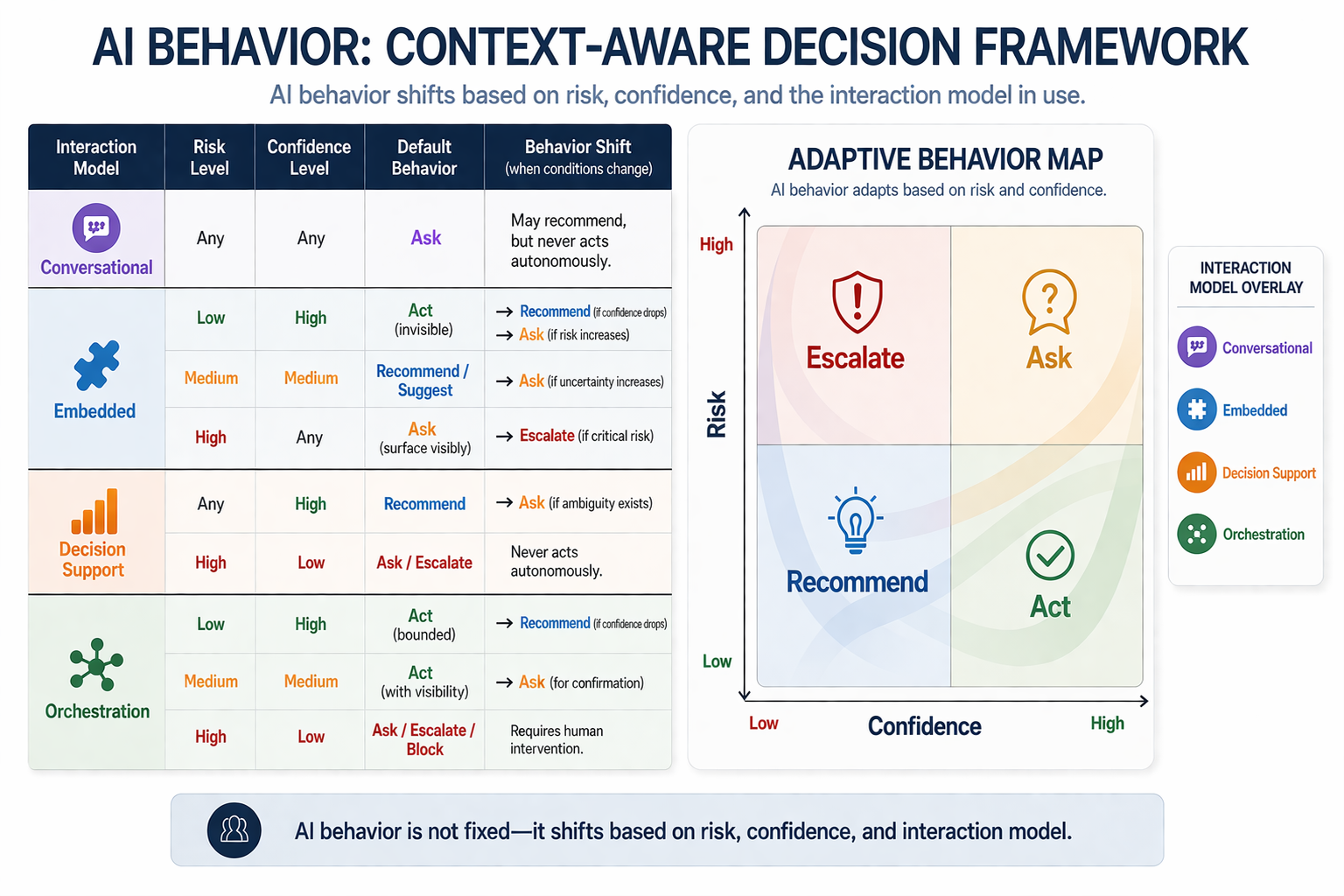
Example artifact: AI systems should be designed around behavior, not just functionality.
A simple model for AI behavior
I think about AI experience through four core behaviors. The quality of the experience depends on how well the system chooses between them.
Recommend
Provide direction when confidence is high and the user would benefit from guidance.
Ask
Request clarification or input when uncertainty exists or additional context is needed.
Explain
Make reasoning visible so users can understand what the system is doing and why.
Escalate
Hand off to human judgment when risk is too high or the consequences of being wrong are significant.
Good AI experiences are defined less by what the system can do, and more by how it behaves in context.
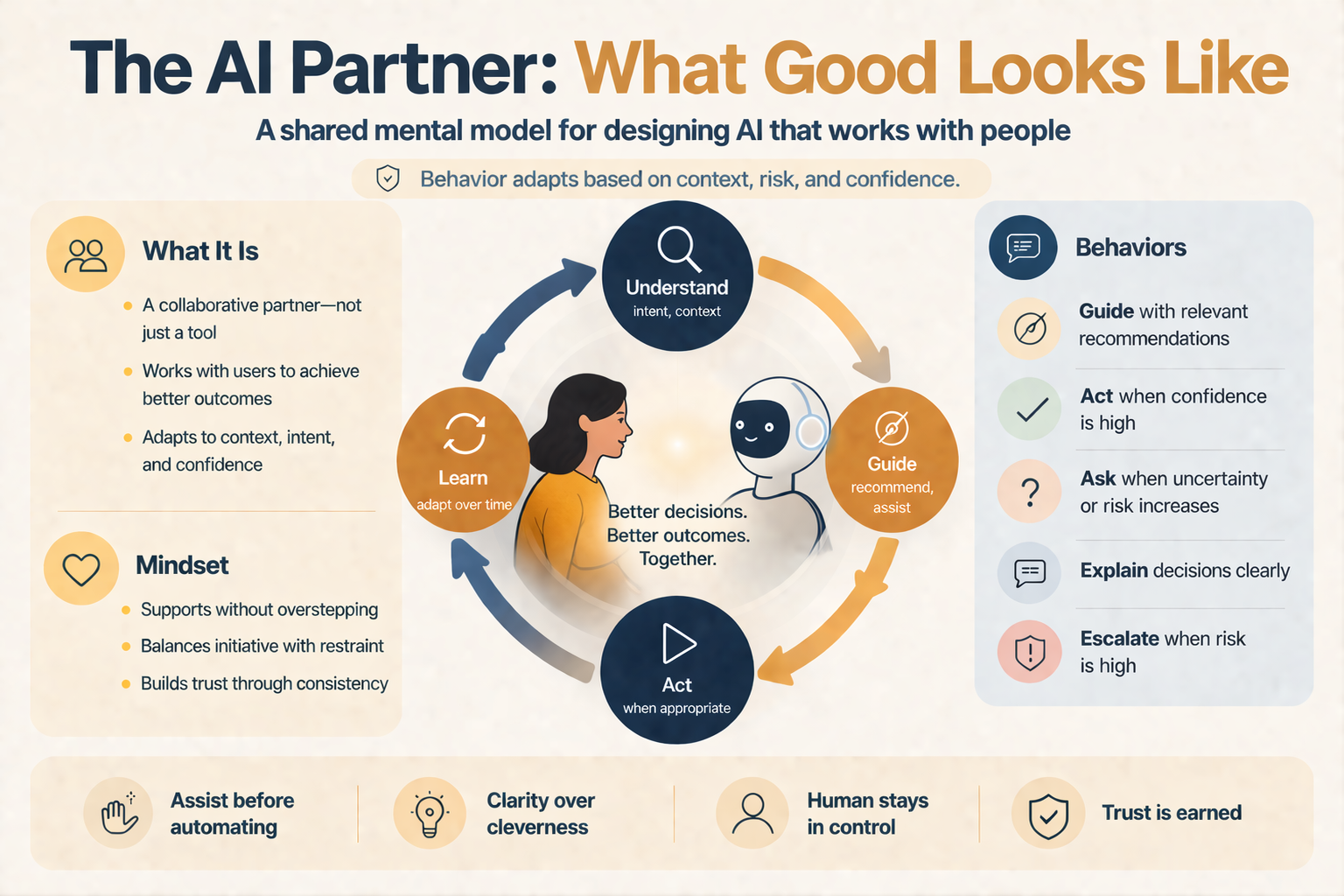
Example artifact: a shared model for defining how AI should behave as a collaborative partner within a workflow.
Applying the model to real workflows
In practice, this means designing AI that fits naturally into the flow of work.
Instead of interrupting the user with a separate AI interaction, the system can guide decisions, surface tradeoffs, explain recommendations, and defer to the user at the moments that matter most.
This becomes especially important in enterprise environments where workflows are complex, stakes are higher, and trust has to be earned through consistency, transparency, and control.
Guide decisions instead of replacing them
Adapt behavior based on confidence and risk
Keep humans in control at critical moments
Make the system’s reasoning visible when it matters
This changes how teams build products
Designing AI experiences well is not just a UI challenge. It changes how teams need to work together.
Product, Design, Engineering, and Research need shared ways to define the role AI plays in the workflow, how the system behaves under different conditions, where human control and oversight are required, and how quality is evaluated once the experience is live.
That is why I’ve become increasingly interested in frameworks, playbooks, and evaluation models that help teams move beyond feature thinking and toward more consistent, behavior-driven product decisions.
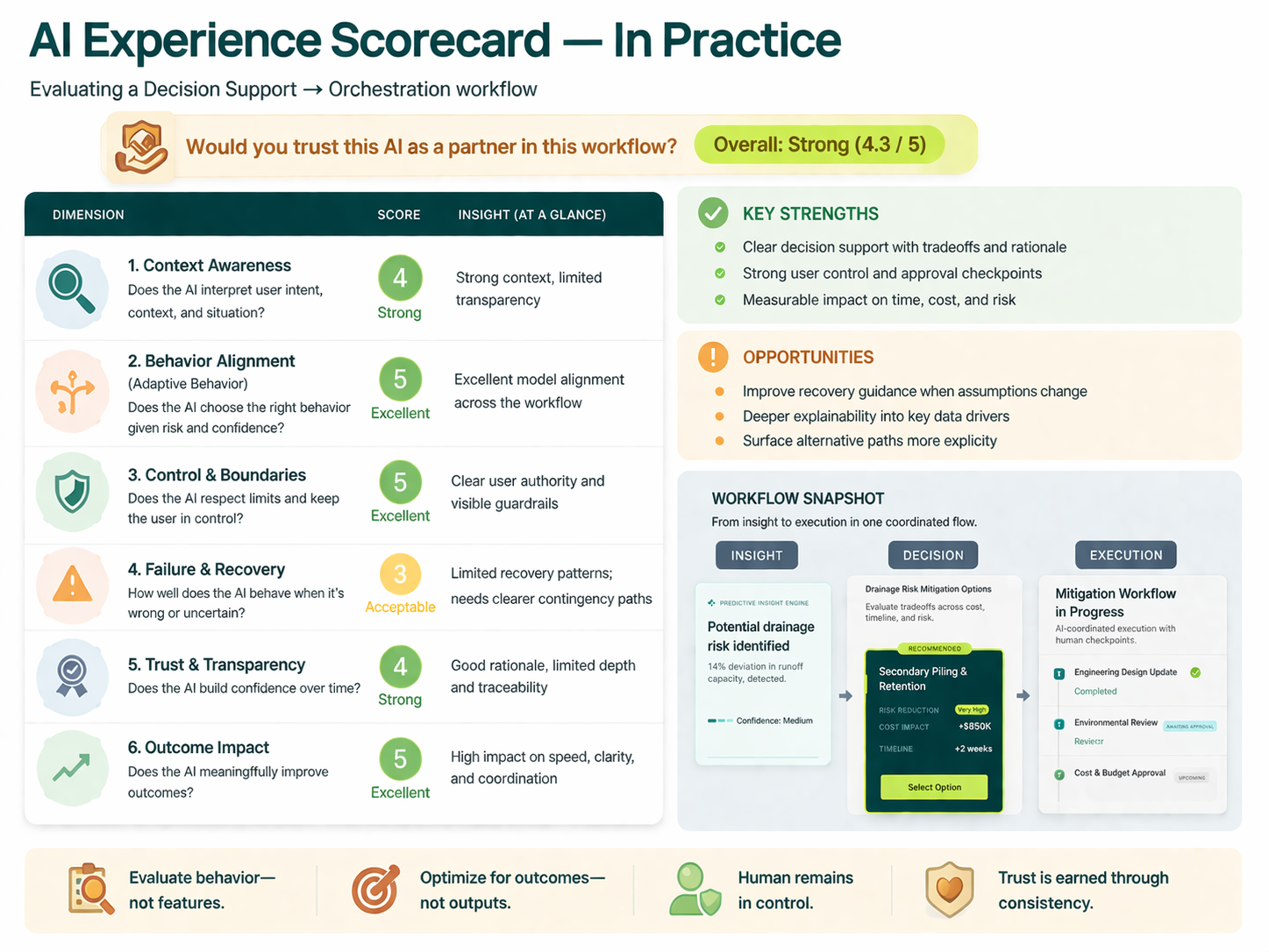
Example artifact: a scorecard used to evaluate whether an AI-enabled workflow earns trust through behavior, transparency, and control.
Where this is going
As AI becomes more embedded across products, the teams that succeed will not simply be the ones with access to the strongest models.
They will be the teams that design the most effective interactions. The ones that know how to shape system behavior, align teams around user outcomes, and create experiences people can actually trust.
Interested in how this applies to enterprise systems, AI product strategy, or complex workflow design?
Let’s connect.